Flexo Station Module
Stable ink film, anilox selection and repeatable plate-to-plate registration for brand-critical solids and line work.
Gallus technology is less about a single headline module and more about sequence. A premium label may need flexo density, opaque white, inkjet variation, varnish texture, cold foil, servo die-cut and a color-managed workflow in the same production release. The architecture below shows how those decisions connect.
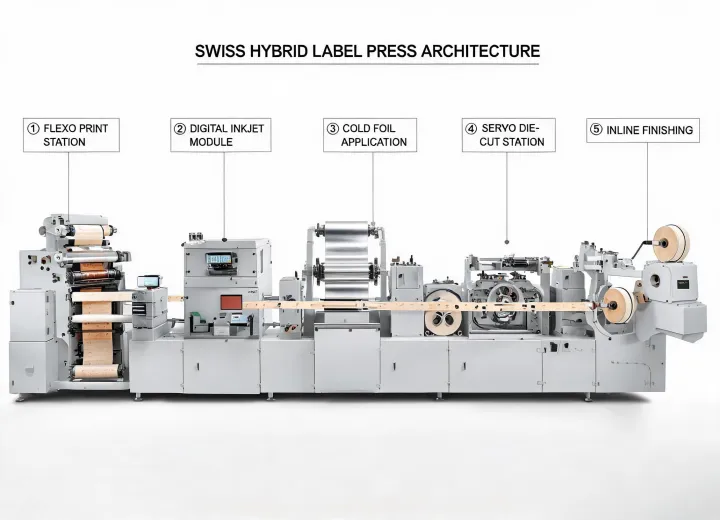
Stable ink film, anilox selection and repeatable plate-to-plate registration for brand-critical solids and line work.
Digital variation, fine image work and hybrid color expansion in the same press workflow.
Cold-foil, hot-stamp and varnish effects specified around substrate behavior, speed and final label handling.
Registration between print and cut treated as a measurable process variable, not a final-line correction.
Lamination, matrix stripping, slitting and rewind control designed into the press layout from the first trial.
RIP, color profiles, recipes and operator settings organized to reduce variation between approved sample and production run.
| Control Point | Measured During | Gallus Evidence |
|---|---|---|
| Web tension | Substrate qualification | Tension recipe with material notes |
| Plate-to-plate register | Flexo baseline run | Register target sheet and operator sign-off |
| Inkjet to flexo alignment | Hybrid trial | Labelfire print sample and measurement record |
| Foil placement | Finishing validation | Foil station setup and waste curve |
| Die-cut position | Servo die-cut run | Cut-to-print measurement log |
| Color drift | Production simulation | Delta-E report and ICC profile note |
| Operator recovery | Training handover | Restart checklist and documented adjustments |
Gallus color work starts with the label substrate and the finishing requirement. The team records ink family, anilox volume, digital profile, proof target and measurement method, then compares production output against the approved standard. This gives converters a disciplined way to discuss Delta-E movement with brand owners and regulated customers.
For pharmaceutical labels, the press architecture must support change control, legible small type, barcode confidence and controlled production release. Gallus can structure IQ/OQ-oriented evidence around installation, operator qualification, recipe control, print inspection and handover. The result is not a generic claim of compliance; it is a practical file that the converter can align with its own quality system.